Of the four tabby patterns, ticked is the weird one. Everything is lines and dots and swirls and something you can point at and name; every one of these types of fish has something in common. From a distance, a few feet away, it looks like a plain tabby cat. No swirls. No stripes. Anything called “pattern” is not that. Go closer, but it’s still there. That’s just because it’s constructed one hair at a time, rather than all at once over the entire coat; hence the confusion!.
The Hair Does the Work, Not the Coat
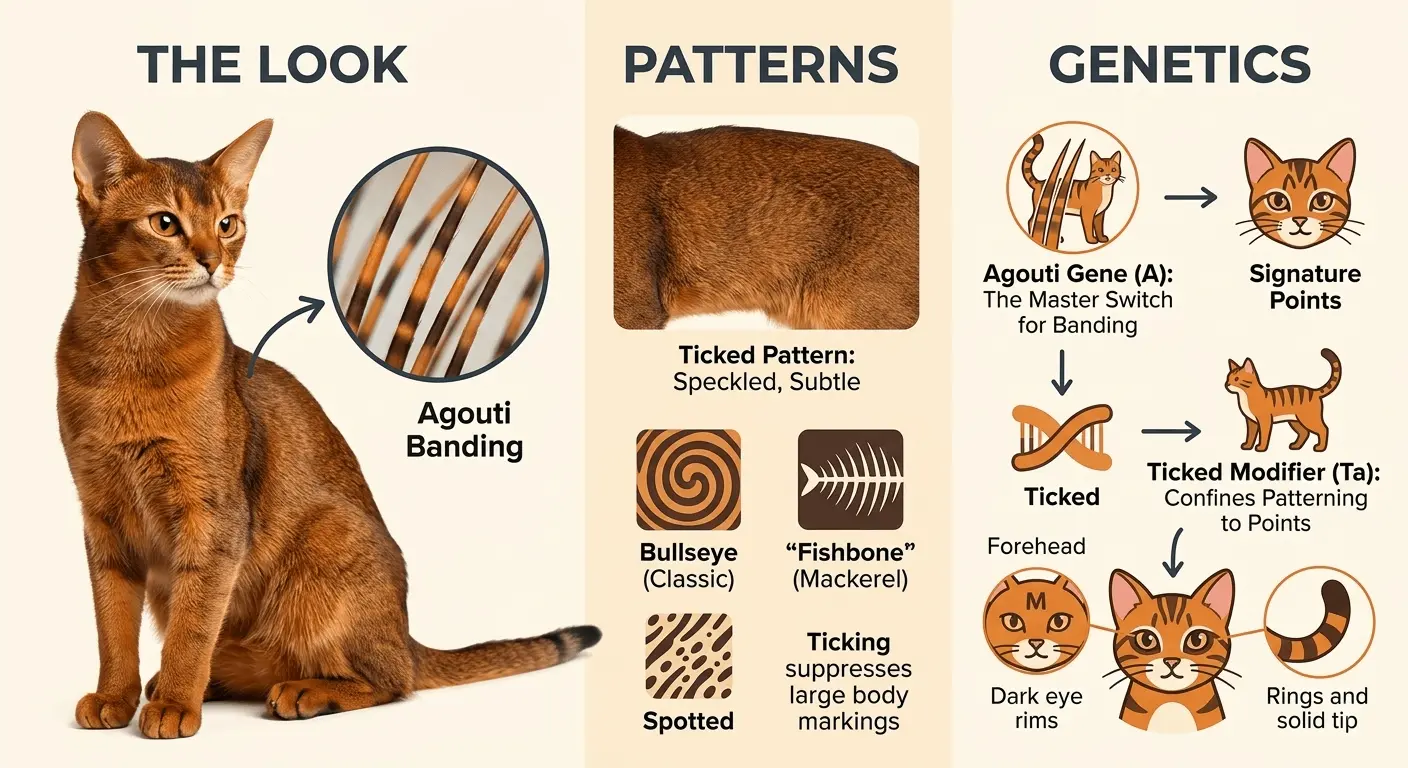
Take one hair from the tabby and notice the bands of light and dark within it. The agouti is the name given to that banding, which was borrowed from the gene that was first discovered in a rodent. So do rabbits, and lots of wild mammals, too.
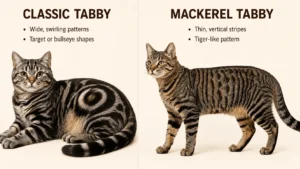
Since the color change is not occurring across a “patch” of coat, but rather within your individual hair, you see it as “texture” (sandy, speckled, a little grainy), rather than shape. That’s contrasted with a mackerel tabby, which has a patch of dark hairs all together as one stripe. Although both begin with the same base gene, it is an entirely different mechanism.
How It Stacks Up Against the Other Three
The same tabby gene is responsible for all four tabby patterns. A second gene is added, which determines what the base pattern will manifest in the cat. In a ticked cat, this second gene primarily turns the stripes and spots off of the body, but not all over. Even fully ticked cats may have faint barring remaining on the face, legs, and tail.
Ticked is the quietest of the four beside mackerel’s narrow parallel lines, classic’s wide swirls, and spotted’s broken-up dots. It’s also the one that people interpret as “no pattern”, but that’s not genetically true; there’s a pattern, it just doesn’t shout about it.
What You’ll Actually See on a Ticked Cat
Most ticked tabbies, even if the body pattern is extremely subdued, have the typical tabby calling cards, and the same signatures you’d see on a mackerel or classic cat:
An “M” on the forehead, although it may be lighter than the one on the cat or mackerel. Rings around the tail. Lines around the eyes. A little light barring on legs that doesn’t entirely go away, even when the rest of the coat is as dark as can be.
The overall coat color is more or less uniform than other tabby types, because there is no pronounced light/dark contrast to interrupt or interrupt the visual flow of the coat. The “sandy” or “ruddy” appearance that is attributed to breeds such as Abyssinian is derived from that.
Breeds Built Around This Coat
Some breeds are simply ticked;
Abyssinian is at the top of the list, which is really the breed that comes to mind first when you think of “ticked tabby. Actually, Somalia is the long haired cat of that same one, with the same fur underneath all the fur. Singapura’s version is also smaller, and a very sepia tone compared to the other two. It will sometimes be seen in Maine Coons and American Shorthairs as well, but it isn’t necessarily seen in those breeds, just now and then, and classic and mackerel are far more common.
Ticked also appears in mixed breed cats, although it isn’t as common as mackerel or classic.
The Genetics, Stripped Down
The base Tabby gene (Ta) is what is responsible for getting any cat a tabby pattern in the first place — if you skip it altogether, you will get a solid-colored cat with no pattern anywhere. Then there’s a different modifier that determines if that pattern is a classic, mackerel, or spotted pattern. Ticked works on its own track. The current explanation is that it occurs in another pathway that, in the vast majority of cases, overrules the exterior expression of other patterns on the body, even though the instructions for these patterns are still there but not being expressed.
For this reason, breeders sometimes find light striping to appear on a fully ticked cat (typically on the face or legs). Not all places the override is 100% effective. It simply has the most impact in the center and least at the corners.
Ticked and Agouti – Same Thing?
Nearly, but not quite the same. Agouti means the hair structure that it produces, and the mechanism that causes it to create ticking in the first place. All tabbies have ticked fur. In the other three tabby patterns, however, the agouti gene is probably still part of the pattern-forming machinery, but is simply covered up and hidden by the more dominant stripe/spot patterned genes.
Frequently Asked Questions
What makes a ticked tabby different from other tabby cats?
The pattern forms inside individual hairs through color banding, not across the coat as visible stripes or spots.
Do ticked tabbies have any markings at all?
Yes, most still carry the forehead “M,” tail rings, and dark eye rims, even with no obvious body pattern.
Is the ticked pattern rare?
Not rare, exactly, but noticeably less common than mackerel or classic outside of breeds specifically built around it, like the Abyssinian and its close relatives.
Can a ticked tabby have kittens with a different tabby pattern?
Yes. Multiple genes are involved in the process, so kittens can end up with a different tabby pattern than their ticked parent had, particularly if the other parent happens to carry classic, mackerel, or spotted genes instead.