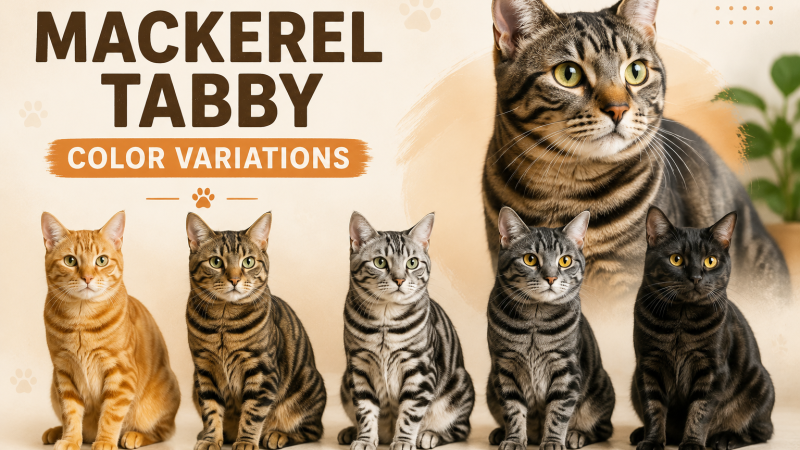
The mackerel stripe pattern is actually a layout. The color underneath it is controlled by a completely different set of genes. That’s why mackerel tabbies show up in almost every base color a cat can have. Some are as common as can be. Others are genuinely hard to find, including cinnamon, lilac, fawn, and chocolate mackerel tabbies, covered further down.
Mackerel Tabby Colors, Compared
| Color | What It Looks Like |
| Brown mackerel tabby | Black stripes over a warm brown coat, the original wild-type look |
| Orange mackerel tabby | Reddish-orange stripes on a lighter orange base; always shows at least some tabby pattern |
| Grey mackerel tabby | Also called blue mackerel tabby; soft gray stripes on a cooler gray coat |
| Blue mackerel tabby | Formal cat-fancy term for the gray version above; a diluted black coat |
| Silver mackerel tabby | Black stripes over a near-white base — bold, high-contrast look |
| Cream mackerel tabby | Pastel version of orange; soft, low-contrast stripes that can be hard to spot |
| Solid black (hidden mackerel pattern) | Pattern hidden under the black coat; faint ghost stripes may show in strong sunlight |
Why Brown Is the Most Common Color
When people think of tabby, they think of brown mackerel, a warm brown coat with black stripes. This is the closest match to the coat of the African wildcat, the ancestor of domestic cats, which is why it’s the natural, wild-type color and turns up constantly in random-bred cats. It’s commonly seen in domestic mixed-breed cats, shelters, and feral populations.
The Truth About Orange Mackerel Tabbies
Orange mackerel tabbies wear reddish stripes over a lighter orange background. Here’s a fact that surprises a lot of people: a truly solid orange cat doesn’t exist. The orange gene doesn’t fully suppress tabby markings, so every orange cat you’ve ever seen was showing some kind of tabby pattern, whether it was obvious or barely there.
| Why so many orange cats are male:● The orange gene sits on the X chromosome.● A male cat needs only one copy of the gene to turn orange.● A female cat needs a copy on both of her X chromosomes — a much less likely combination.● Result: roughly 4 out of 5 orange cats are male. |
Gray, Blue, and Silver: Sorting Out the Cool Tones
Gray mackerel tabbies and blue mackerel tabbies are identical. Breeders refer to a diluted black coat as blue. Most owners use the word gray instead. Either way, you get soft, cool-toned stripes on a lighter gray base.
Silver mackerel tabbies push that contrast even further. Picture black stripes on an almost white, silvery background. The effect is easy to spot from across a room, and it’s especially well known in breeds like the American Shorthair and Maine Coon.
Cream: The Color That’s Easy to Miss
Cream mackerel tabbies are a light, pastel version of orange. Picture a soft, warm cream background with subtle stripes running through it. Cream stripes often become harder to distinguish because of naturally low contrast, not just bright light. At first glance a cream mackerel tabby may look nearly solid, but the pattern reveals itself once you catch it in the right lighting.
Why Do Black Cats Sometimes Show Faint Stripes?
Many solid black cats carry tabby pattern genes underneath their coat. In a black cat, a separate gene overrides those markings, so they aren’t normally visible — the pattern is still genetically present, just hidden beneath the solid black coloring.
| Ghost striping, explained:● In strong sunlight, a faint striped outline can sometimes show through — cat lovers call this ghost striping.● It’s most noticeable on kittens, since their coats haven’t fully darkened yet.● As a kitten matures, the black pigment deepens and those ghost stripes fade further out of view. |
Which Mackerel Tabby Colors Are Genuinely Rare?
Brown and orange mackerel tabbies are everywhere. These are the colors you’re most likely to see in shelters and roaming outside. Cinnamon, lilac, fawn, and chocolate mackerel tabbies are among the rarest visible colors.
These less common colors come from recessive gene combinations that are uncommon in random-bred cats. Cinnamon, for instance, is a feature of certain pedigreed breeds such as the Abyssinian. You’re far more likely to see cinnamon or lilac mackerel tabbies at a cat show than in your own backyard.
A Quick Tip for Spotting Color in Poor Light
Cat coats can look different depending on the light around them. A brown mackerel tabby photographed under yellow indoor light might look almost black. The same cat outside in daylight often reveals its true warm brown tones. If you’re unsure about a cat’s exact color, view it in natural daylight first. It makes a real difference.
How Color and Pattern Work Together
It’s worth remembering that color and pattern are two genetically distinct systems that get inherited together. Pattern genes determine how the stripes are arranged across the body, while color genes determine the pigment inside those markings. A kitten might inherit the mackerel trait from one parent and an orange coat from the other, and the result is an orange mackerel tabby. Color and pattern travel through different genetic mechanisms, but they combine to produce the cat’s final appearance. That’s also why two kittens from the same litter can look entirely different, even though they share the same parents and the same coat structure underneath.
Frequently Asked Questions
What is the most common mackerel tabby color?
Brown mackerel tabby is the most common. It features black stripes over a brown coat, similar to the coat of the African wildcat.
Can black cats have hidden mackerel tabby stripes?
Yes. The stripes are genetically present but hidden by the black coat. They sometimes appear as faint ghost stripes in strong sunlight.
What is the rarest mackerel tabby colour?
Cinnamon, lilac, fawn, and chocolate mackerel tabbies are the hardest to find. Most are limited to specific pedigreed breeds.
Is a silver mackerel tabby different from a grey one?
Yes. Silver has a much paler, almost white background with sharp black stripes. Grey, or blue, mackerel tabbies have a softer, more even grey tone throughout their coats.
Why do orange mackerel tabbies always show stripes?
The orange gene cannot fully hide tabby markings. Because of this, every orange cat carries some visible tabby pattern, even if it looks faint.