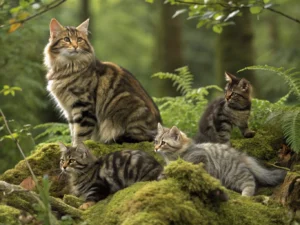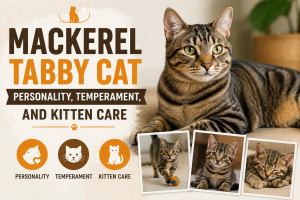
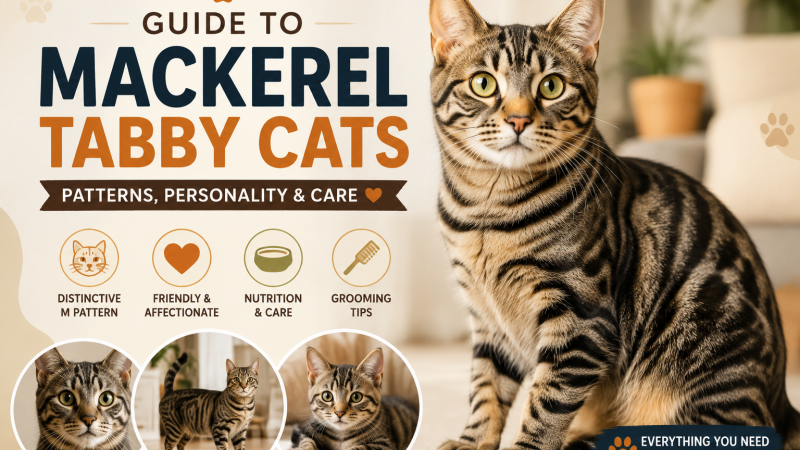
Mackerel tabby’s are the ones you’ve seen with stripes running in parallel down their sides like a mini tiger. This is the easiest to identify tabby pattern and it is also the most common. That’s because, before cats were domesticated, mackerels have been the original coat pattern that they have worn.
This guide is about the nature of a mackerel tabby, where it is genetically found, the colors it can be found in and the rarity of it. (In short answer, that is not anywhere near right.
What Is a Mackerel Tabby Cat?
A mackerel tabby cat is one with narrow parallel stripes on its sides, which radiate out from a stripe down the back. It’s actually similar in structure to a fish’s skeleton, hence the name. The pattern is also known as “fishbone tabby” due to the resemblance to fishbones and “mackerel” is the name given to the fish.
A mackerel tabby has a tabby pattern with the characteristic M-shaped marking on its forehead, fine tracing lines around the eyes and ringed banding on its legs and tail, as in all tabbies. Some mackerel tabbies even sport a few small dark spots sometimes referred to as a “peppered nose” on the nose leather.
Mackerel is a coat pattern, and is found in almost every cat breed with tabby genes, whether they’re Maine Coons or just average domestic shorthairs.
The Mackerel Tabby Pattern, Explained
Mackerel is the wild type in terms of genetics. In the wild, the stripes would serve as a natural camouflage in the grass and scrubland, and this is the coat that the domestic cat’s ancestors – the African wildcat and the European wildcat – wore in the wild. All other Tabbies are simply a variation of this Tabby.
Mackerel is also the dominant pattern over the classic (blotched) pattern. In order for a cat to have stripes, he must have one mackerel gene, while two copies of the mackerel recessive gene will produce the classic swirled pattern. In part, it’s just why mackerel keeps turning up when a mackerel parent breeds with a classic-carrying partner, it is likely that striped kittens will still be born, even if they also carry the secret gene.
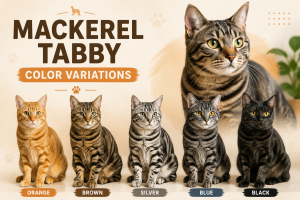
Mackerel Tabby Colors
The mackerel stripe pattern can sit on top of almost any base coat color. Here are the most common ones:
| Color | Description |
| Brown mackerel | Black stripes over a warm brown or gray-brown background; the closest match to the wild ancestor coat |
| Orange mackerel | Reddish stripes over a lighter orange ground; every orange cat shows some tabby pattern, since the orange gene can’t fully mask it |
| Grey (blue) mackerel | Soft blue-gray stripes over a paler gray coat |
| Silver mackerel | Black stripes over a pale, almost white-silver background — high contrast and striking |
| Cream mackerel | A diluted, pastel version of orange; soft cream stripes that are easy to miss in bright light |
| Black mackerel | Stripes present but hidden by the solid black coat; often only visible as faint “ghost stripes” in direct sunlight |
Are Mackerel Tabby Cats Rare?
No mackerel tabbies are about as far from rare as a cat can get. It is the most widely seen tabby pattern in the world and is genetically dominant so it is found in random-bred and shelter cat populations all over the world.
The colour in which a mackerel pattern appears can be rare. The other colors, cinnamon, lilac, fawn, and true black mackerel tabbies, are much more difficult to come by than the common brown or orange tabbies and some limited colors are only available in certain pedigreed breeds. If anyone asks if their tabby mackerel is special: its pattern is not unusual, but certain colors are.
A Bit of History
It is thought that the word “tabby” originated from “Attabiyah,” a district of Baghdad where a striped type of silk was originally manufactured, “Atabi.” When the fabric arrived in England, the resemblance was seen with the striped cats and the term persisted.
The peculiar cultural side note of the mackerel tabbies is that in the 16th and 17th centuries in Europe mackerel tabbies, especially females, were sometimes viewed as magical companions and linked to witchcraft. Most of that superstition has gone, though cats in general continue to be wrapped up in folklore today.
Frequently Asked Questions
What is a mackerel tabby cat?
The most common tabby coloration is narrow parallel stripes on its sides branching off a single stripe down the spine, very similar to the tabby-like coat of its wild cousin.
Is mackerel tabby a breed?
No. It’s a coat type that can be found in dozens of breeds and is present in mixed-breed cats around the world.
Are mackerel tabby cats rare?
No, they’re the most common tabby pattern you can find. The pattern itself isn’t uncommon; certain colours of mackerel tabby are uncommon.
What’s the difference between mackerel and classic tabby?
Mackerel is known for its narrow parallel stripes, and classic is known for its broad, swirling bands in a bullseye pattern. In addition, mackerel is genetically dominant and classic is recessive.
What colors do mackerel tabbies come in? Brown, orange, gray, silver, cream and even black (although the black mackerel stripes get lost in normal light, or only appear as ghost stripes in sunlight).