There is more than one style of tabby cat, and two tabby coat patterns are often mixed up: classic and mackerel. Both have the little M on their forehead. Both belong to the same general gene family. However, once you know what to look for, these two tabby cat patterns are easy to tell apart.
The Quick Answer
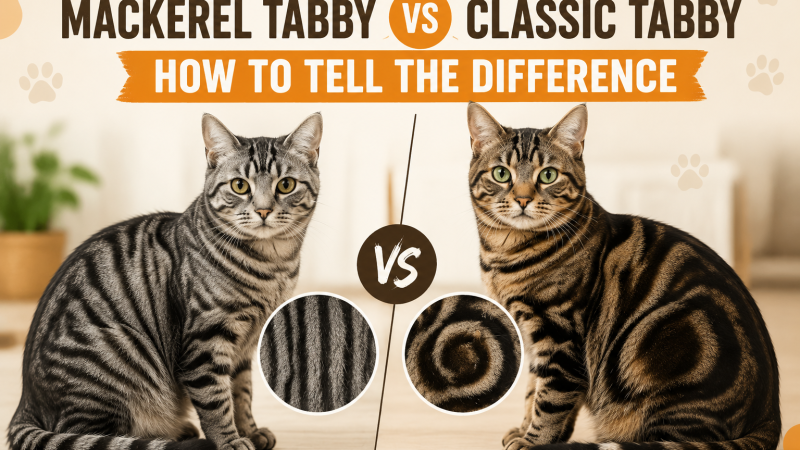
Mackerel tabbies have narrow stripes running down the sides, similar to a tiger. Classic tabbies feature wide bands that curl into a bullseye or marble pattern on each flank. Straight lines point to mackerel tabby markings. Swirls and blotches point to classic tabby markings.
Classic Tabby vs Mackerel Tabby: Side by Side
| Feature | Mackerel Tabby | Classic Tabby |
| Body pattern | Narrow, parallel stripes | Wide, swirling bands (bullseye shape) |
| Other names | Fishbone tabby, tiger tabby | Blotched tabby |
| Genetics | Dominant allele at the Tabby locus | Recessive allele, needs two copies |
| How common | Most common tabby type | Common, but seen less often |
| Shoulder marking | Plain stripe lines | Often a butterfly shape across the shoulders |
| Ancestral pattern | Closest to the ancestral wild-type pattern | A later variation on that pattern |
What Every Tabby Cat Has in Common
Before getting into the differences, it helps to know what mackerel and classic tabbies share. Every tabby coat pattern, not just these two, comes with a few signature features: the M mark on the forehead, thin dark eyeliner around the eyes, bars circling the legs, and rings around the tail. Those traits show up regardless of which pattern a cat carries.
Classic and mackerel are simply the two most common members of a larger family of tabby coat patterns. Cats can also carry spotted, ticked, or patched (torbie) tabby patterns, each shaped by its own mix of genes. This article focuses on classic and mackerel since they’re the two people confuse most often, but it’s worth knowing they aren’t the only types of tabby cats out there.
The Genetics of Classic vs Mackerel Tabby Patterns
Both patterns are controlled by the same genetic locus, called Taqpep. The specific version of that gene a kitten inherits decides which pattern shows up.
Mackerel is generally the dominant form, so a single copy is enough to produce stripes. Classic tabby markings are generally recessive, meaning a cat usually needs two copies, one from each parent, before the swirls appear.
That dominant-recessive split is the basic rule of thumb, though real tabby cat genetics is a bit more layered than a single gene switch. Other genes, including the one that controls the ticked pattern, can interact with the Tabby locus and shape how a pattern actually looks.
Because mackerel only needs one copy to show, a cat can quietly carry the classic version for generations without anyone knowing. The swirled pattern only appears once two hidden carriers pair up, each passing down its silent copy at the same time.
That same Taqpep gene turned out to have a wider reach than anyone expected. Researchers first identified it in 2012 while studying feral cats.
They later found that a related mutation in the very same gene is behind the bold, merged markings on rare king cheetahs. It’s a striking link between an ordinary house cat and one of its much larger wild relatives.
Classic Tabby vs Mackerel Tabby: How to Identify Them
Here’s a quick, scannable way to check which pattern you’re looking at:
● Flanks (most reliable): Evenly spaced, straight lines running down the body point to mackerel. Large, curved shapes, swirls, or a target-like pattern point to classic.
● Shoulders (a supporting clue, not a firm one): Classic tabbies often show a marking that resembles a butterfly across the shoulder blades, while mackerel tabbies usually don’t. Shoulder markings vary a lot from cat to cat, so treat this as backup evidence, the flank pattern is what actually settles it.
● Still unsure? Mackerel is the safer guess, simply because it’s the pattern most tabby cats end up carrying. That’s not a diagnostic rule, though, whenever you can get a clear look at the cat’s side in good light, let the actual stripes or swirls make the call.
Why the Mix-Up Happens So Often
Part of the problem is that both patterns can turn up in the same litter. Even though every kitten shares the same parents, a mother cat carrying both genes may have some kittens with crisp, straight stripes and others with soft, curling patches.
Poor lighting doesn’t help either. A mackerel tabby caught at an odd angle can look blotchy in a quick photo, and the same can be true of a cat whose stripes are slightly broken or wavy. Getting a clear look at the cat’s side in good light usually settles the question within seconds.
There’s one more wrinkle: fur length. Long-haired cats can blur their own markings, since thicker fur gives the pattern more room to spread and soften. A long-haired mackerel cat may end up with stripes that look wide and hazy instead of sharp, which can make it appear more like a classic tabby than it really is.
Age plays a role too, though less dramatically than people assume. The pattern is already present at birth, but it usually looks softer and less defined on very young kittens. As a kitten grows, the markings tend to gain sharper contrast and become easier to read, so a coat that looks uncertain at six weeks often comes into clearer focus a few months later.
Does the Pattern Actually Matter?
Not in any way that relates to health or personality. Both patterns are simply coat variations, and both are common. Neither one makes a cat a better or worse pet.
That said, certain breeds and cat shows do favor one look over the other. British Shorthairs, for instance, are best known for their solid blue coat, though the breed does also come in classic tabby and other patterns. Cats from outdoor or working lines tend to lean mackerel more often. Some breeders even pair two carrier cats on purpose to raise the odds of classic kittens in a litter. If you’re choosing a pet rather than a show cat, though, the pattern really just comes down to personal taste.
A Quick Word on Kittens
Guessing a kitten’s pattern takes a little patience. Some newborns have markings that look fuzzy or are hard to read at first. Give it a few weeks. The pattern usually gains sharper contrast and becomes easier to identify as the kitten grows.
Frequently Asked Questions
What is the main difference between classic tabby and mackerel tabby?
Mackerel has narrow, parallel stripes. Classic has wide, swirling bands that form a bullseye shape on the cat’s sides.
Which is more common, mackerel or classic tabby?
Mackerel wins by a wide margin. It’s generally the dominant form at the Tabby locus, while classic is generally recessive and needs two gene copies to show up.
Can one cat show both patterns at once?
Not as two fully separate patterns, but the coat can still look like a mix. Broken or wavy mackerel stripes can read as swirled or spotchy in places, especially in poor light or on a long-haired coat, which is why a cat can sometimes seem to blend both looks. Genetically, though, a cat’s coat only expresses one pattern at a time, and it can carry a hidden gene for the other to pass on to its kittens.
Is one pattern healthier than the other?
No. Both are simple coat variations with no tie to a cat’s health, smarts, or personality.
Why do kittens in the same litter sometimes look so different?
When both parents carry hidden copies of different tabby genes, a single litter can end up with a real mix of mackerel and classic kittens.
Sources: Feline tabby pattern genetics draw on the 2012 Taqpep gene study covered by Live Science and EveryCat Health Foundation, along with background on tabby coat genetics from Wikipedia’s tabby cat entry. For a deeper technical read, a veterinary genetics resource on the Taqpep and Agouti genes is a good next stop.
Suggested images for this post: a side-by-side photo comparing mackerel stripes and classic swirls; a close-up flank shot of each pattern; a shoulder-marking comparison showing the classic “butterfly”; and a clear bullseye-pattern close-up on a classic tabby’s side.