Have you ever seen a cat with stripes or the fishbone pattern down its sides? You’ve met a tabby. Perhaps you’ve seen the little “M” stamped on top of its eyes… So, what is a tabby cat anyway?
A tabby is not a breed; it’s one of the most frequent inquiries made by new cat owners, and many people are surprised to find out. A coat pattern that occurs in dozens of breeds and shows up in millions of mixed-breed cats around the world, tabby-marked cats can be found in Egyptian art dating back thousands of years, making this one of the oldest coat patterns in the domestic cat.
Learn all about tabby cats in this Tabby Facts Guide, which includes their genetics, personality traits, daily care, and colors. It also provides solutions to the most common questions new owners have. If you already own a tabby cat or are considering adopting one, then you’ve found your tabby cat guide.
Quick Facts
| Fact | Detail |
| Breed status | Not a breed—tabby is a coat pattern |
| Lifespan | 12–18 years on average |
| Weight | 8–12 lbs (domestic shorthair); larger for breeds like Maine Coon |
| Wild ancestor | African wildcat (Felis lybica) |
| Main patterns | Mackerel, classic, spotted, ticked, patched (torbie/caliby) |
| Sleep | 12–16 hours a day, like most cats |
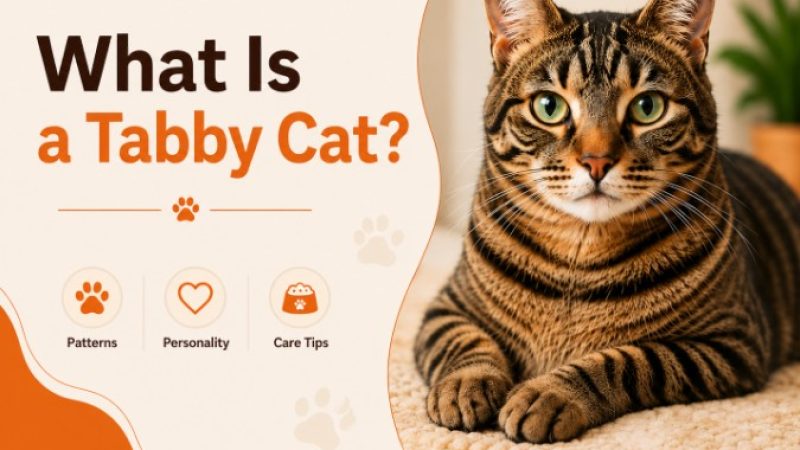
What Is a Tabby Cat?
Any cat with a striped, swirled, spotted, or flecked “ticked” coat pattern is a tabby. Almost all tabbies also have a mark on the forehead, which is M-shaped. The word refers to a pattern, not to a breed, size, or temperament of the animal. This is perhaps why tabby cats occur in all kinds of colours, lengths and shapes of coats.
It can be traced back to the African wildcat (Felis lybica), the wild ancestor of the domestic cat, which relied on its striped coat as natural camouflage. This is a true ancient trait with tabby markings, which are found in Egyptian tomb paintings more than 3000 years old. The appearance of the markings on a typical house cat is determined by a few genes. The pattern is merely on/off by one gene called “agouti.” The exact style (mackerel, classic, spotted, or ticked) is determined by other genes.
There’s a fun story behind the name. It is believed that it is derived from “Attabiyah,” a region of Baghdad where the silk “Atabi” was once produced in stripes. The fabric was transferred to England, and its likeness to striped cats was observed, and “tabby cat” stuck.
Is a Tabby Cat a Breed?
It’s a question that novices often ask, and the answer is that a tabby does not signify a cat breed. “Tabby” is a coat pattern, and it reveals itself in purebred cats like the Maine Coon, American Shorthair, Bengal, Abyssinian, British Shorthair, and Scottish Fold. It’s seen equally often in domestic shorthairs, domestic longhairs, and all other types of mixed-breed cats. Domestic shorthair is one of the most common tabby-patterned cats found in shelters.
This is also the reason why tabbies come in different sizes, coat lengths, temperaments, and health. Although both cats are “tabbies,” a tabby Maine Coon cat looks and acts very differently from a tabby domestic shorthair. So people who ask about how to recognize a tabby cat are actually asking about how to recognize the pattern, not a breed, and this pattern can be found on nearly any body type of cat.
Types of Tabby Cats
The secret to tabby cat types is genetics, but it’s not a requirement to be a scientist to join the journey. To summarize: The tabby pattern is only seen in cats when it is coupled with a certain set of coat-color genes. There are four basic tabby patterns and a fifth that is a combination of two coat traits. Let’s look at how to tell the difference between each type.
| Pattern | How to Spot It | Often Seen In |
| Mackerel | Narrow, parallel stripes running down the sides, like fish bones | Domestic shorthairs, Bengals |
| Classic | Bold, swirling bands in a bullseye or marble-cake shape | British Shorthair, American Shorthair |
| Spotted | Spots instead of stripes, in varying sizes | Ocicat, Bengal, Egyptian Mau |
| Ticked | No clear stripes or spots; each hair has light/dark bands | Abyssinian, Somali |
| Patched (Torbie/Caliby) | Tabby striping mixed with tortoiseshell or calico patches | Mixed-breed cats |
Mackerel Tabby
The most common pattern, and closest to the original wildcat coat, is Tabby. It is narrow with parallel stripes that branch off of one stripe down the spine. The design is similar to that of fish bones. Cats with neat “tiger stripes” are called mackerel tabby cat.
Classic Tabby
The “blotched” tabby has big, swirling bands of color and may include a bullseye or marble-cake pattern on each side of the body. More often seen in British Shorthairs and domestic shorthairs throughout the US and UK, it’s the image most people will envision when they think of a tabby cat.
Spotted Tabby
It is a tabby with spots, not stripes, and of varying size on the body. Spotted tabbies are typically mackerel tabbies with an additional gene that creates spots instead of stripes. Some breeds such as the Ocicat, Bengal, and Egyptian Mau are famous for dramatic spotted coats.
Ticked Tabby
The ticked tabby is one in which few or no stripes or spots are seen. Instead, each hair has light and dark bands, resulting in “salt and pepper” coloring. The classic ticked tabbies are the Abyssinian and its long-haired cousin, the Somali. Very few ticked (spotted) cats will not have the M on their forehead and fine lines around their eyes.
Patched Tabby (Torbie and Caliby)
A patched tabby is a tabby with patches of a different color, usually red or cream over brown or grey. When a tabby cat carries the tortoiseshell gene as well, it creates a tabby “and tortoiseshell” coat pattern. This pattern exists in two forms and can be confused with each other:
• Torbie: short for “tortoiseshell tabby.” Tortoiseshell and tabby stripes, typically black, brown, and orange.
• Caliby: short for “calico tabby”. Tabby pattern and calico coloring (white patches in addition to black and orange).
The easiest way to distinguish them: A caliby will always have white patches, and a torbie will not.
Tabby Cat Colors and Patterns.
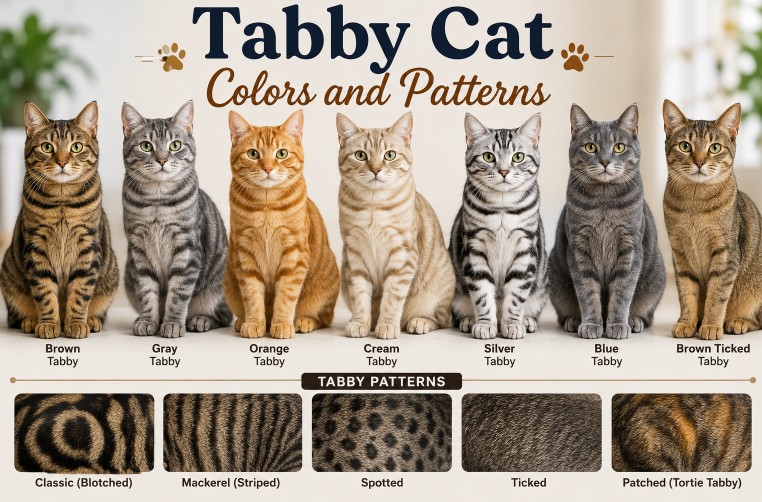
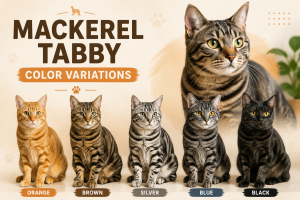
Pattern and color are two different things. Almost every basic color can be used to produce the mackerel, classic, spotted, or ticked patterns. Hence, orange tabby, gray tabby, and brown tabby are not distinct tabby breeds but shades of the same tabby gene.
| Color | Description |
| Orange tabby | Colored by a pigment called pheomelanin, the orange gene rarely masks the tabby pattern, so nearly every orange cat shows tabby markings |
| Brown tabby | The most common tabby coloring, from warm chocolate to golden-brown, with black or dark brown markings |
| Gray tabby | Sometimes called “blue tabby”; cool gray fur with darker charcoal markings |
| Silver tabby | Pale, silvery-white coat with sharply contrasting black markings; common in Maine Coons and American Shorthairs |
| Black tabby | Also called “brown-patched” or melanistic tabby; can look nearly solid black in low light. |
Why Are Orange Tabby Cats Mostly Male?
Genetics. Orange coat color is inherited as a single dominant gene on the X chromosome of the mother, thus allowing for a single gene to carry the orange coat color in males. This is because they must have a copy on BOTH their X chromosomes (more than half a chance), thus about 80% of orange cats are male. Orange tabbies are not just rare; they’re rare females too.
Why Do Tabby Cats Have an M on Their Forehead?
This is a natural occurrence of the tabby pattern and is found in almost all tabby cats; even newborn kittens are tabby with it. From a genetic point of view, it’s just the normal merging of finer lines into an M shape on the face.
The remainder has been supplied by folklore and a few pretty legends. The story goes that the Prophet Muhammad once stroked his cat Muezza’s forehead and was saved from a snake, but Muezza left behind a mark, which is why his forehead has a spot. According to the story, the Prophet Muhammad once stroked his cat Muezza’s forehead, and he was saved from a snake, but Muezza left behind a spot on his forehead. There is a Christian legend, too, that the Virgin Mary blessed a tabby cat that comforted the baby Jesus, who left her initial on the cat’s forehead. The third theory relates the mark to the old Egyptian word for cat, “mau.” These tales are entertaining, but it is really coat-pattern genetics!
Tabby Cat Personality and Temperament
The truth is, there’s no scientific evidence that coat pattern influences personality. Instead of being striped vs. spotted, a cat’s temperament is more likely to be influenced by their genes, early socialization, and environment. For example, a tabby Persian and a tabby Siamese will behave completely differently – the pattern is less important than the breed.
However, tabbies in general have a reputation for being among the most friendly and adaptable cats around, and many owners will say their tabby has its own unique personality; tabbies are even a recurring character in movies (like Garfield) and literature (the Cheshire Cat).
Are tabbies friendly? Generally, yes. Tabbies are considered to be social and curious, participating in household activities. Many are good with children, other animals, and noisy households.
Are tabbies affectionate? The majority of tabbies are social animals and are very close to their families. Are tabbies cuddlers? Many do, but like all breeds, some preferences differ. Some are lap cats all the time;e, others like to stay in close touch but don’t like to be held.
Are tabby cats smart? Tabbies are intelligent and problem-solving. Are fast learners, food motivated, and responsive to interactive toys and puzzle feeders.
Common behaviors owners report with tabbies include:
· Friendly and lively as kittens and young adults
· Curious and quick to explore high places or new objects
· Vocal and communicative; they may “chat” with their owner.
· Works in both apartments and homes that have yards
· Very loyal to favorite people; may follow them from room to room
There is an interesting correlation in owner questionnaires between coat color and some reported personality characteristics, which is why it is included. Orange tabbies are reputed to be particularly relaxed and sociable, for example. Researchers who discovered the gene that causes orange coats also said it’s being expressed all over the body, including the brain, so a connection with behavior is possible but hasn’t been demonstrated. Most experts still believe that more attention should be paid to individual personality, socialization, and environment than to coat pattern or colour.
Common Behavior Challenges
Some tabbies are difficult to pick up, bossy, or reactive when picked up — this may have to do with the way the cat was picked up as a kitten, and not anything to do with their coat. Typically this will pass with time and patience, and through positive reinforcement (treats and praise for calm behavior, not punishment). But if your cat’s behavior is persistently negative when touched, it is important to respect that limit and approach your cat slowly and carefully with contact.
How to Care for a Tabby Cat
The basic rules of caring for tabby cats are the same as those for any cat, as tabby cat care involves caring for any cat with tabby markings. Here’s an easy-to-follow breakdown of tabby cat care.
Tabby Cat Diet
Cats are obligate carnivores, which means that nutrients such as taurine, arachidonic acid, and vitamin A are only found in animal-based products, and these are essential to a cat’s diet. Use a good quality commercial cat food that is appropriate for your cat’s age (kitten, adult, or senior), and make sure the food contains animal protein as the first ingredient. Wet food promotes water balance and urinary well-being. Control portions—indeed, it is about as easy to gain weight indoors as outdoors, primarily because cats are less active in their homes. Treats are kept within 10% of total calories, and fresh water is always provided.
Tabby Cat Grooming
Coat length is what that relates to and not pattern. Short-haired tabbies usually require one brushing each week; long-haired tabbies are best brushed two or three times a week to avoid matting and hairballs. A good grooming includes regular nail trimming, ear checks, and dental work.
Indoor Tabby Cat Care
One of the best ways to prolong the life of your Tabby cat is to keep it indoors as much as possible. Indoor cats are less likely to interact with cars, wild animals, or neighborhood dogs, and studies have consistently demonstrated that indoor cats have much longer lifespans than those that live outdoors. To help prevent an unhappy Tabby in your home, give it:
· Climbing tree or window perch for tall cats to climb and sunbathe on
· Provide scratching posts so that furniture will not be damaged and they will be able to use it as a natural behavior.
· Multiple litter boxes, one for each cat plus one additional, clean boxes
· Allowing toys to rotate to not get bored out of play
It’s also a good idea to set aside a quiet, cozy resting area, far from the litter box, as cats sleep for 12 to 16 hours each day, and a comfortable, safe place to sleep in helps to reduce stress and overall discomfort.
Tabby Cat Exercise
Tabbies are mentally stimulated and physically fit with daily play sessions. Spend time with wand toys, laser pointers, and puzzle feeders! With a laser, always play ending on a real toy, which the cat can “catch.” Typical healthy adult cats are fine with 15-20 minutes of active play twice daily.
Common Health Issues and Lifespan
How Long Do Tabby Cats Live?
Tabby is not a breed, and therefore the cat’s life expectancy can vary greatly depending on the breed and lifestyle of the cat. The lifespan of tabby cats is dependent on a variety of factors such as genetics, diet, exercise, health care, and lifestyle, and can average 12-18 years. Mixed-breed tabbies are likely to have a wider genetic diversity, and a large study of pets showed that crossbreeds lived an average of nearly 12 years, more than most purebred cats due to hybrid vigor. A few tabbies will live into their late teens and early twenties with good indoor care.
How Big Do Tabby Cats Get?
Size is not related to pattern. Domestic shorthair tabbies typically weigh 8-12 pounds, which is fairly thin. Tabby domestic shorthair cats are normally 8-12 pounds, which is relatively thin. Maine Coon is one of the heavier breeds, weighing 15-20+ pounds. The orange tabbies are also known as running a few sizes bigger on average, which may be due to the fact that the majority of them are males and male cats are bigger than females.
Common Health Concerns
Unlike the cat’s coat pattern, none of these health problems are unique to Tabby cats, but to the breed, its genetics,s and lifestyle:
| Condition | What to Know |
| Obesity | One of the most common and preventable issues; linked to arthritis, diabetes, and heart disease |
| Hyperthyroidism | An endocrine disorder in middle-aged and senior cats, causing increased appetite, weight loss, and hyperactivity; usually managed with medication |
| Dental disease | Very common after age three; preventable with regular brushing and checkups |
| Urinary tract issues | Especially common in cats fed mostly dry food with limited water intake |
Regular veterinary checkups, a suitable diet, and a healthy weight are the best protection against these issues, regardless of coat color or pattern.
Are Tabby Cats Good Pets?
For most households, a yes. Tabby cats make wonderful pets, as they are present in so many breeds and so many temperaments. Whether you’re looking for a lap cat or a social and active one, there will be a tabby to suit your lifestyle.
Are tabbies good first-time cats? Generally, yes. Many tabbies are not the high-maintenance house-cat; they are hard, adaptable, and relatively low-maintenance cats who may be a good fit for a fledgling cat owner. However, it is important to know more about a tabby you are considering before you adopt one. Sometimes a shelter will be able to tell you more about a mixed-breed cat’s personality than the coat pattern will.
Frequently Asked Questions About Tabby Cats
What is a tabby cat, in simple terms?
It’s any cat with a striped, swirled, spotted, or ticked coat pattern, usually with an M-shaped mark on the forehead. It’s a coat type, not a breed.
Is a tabby cat a breed?
No. Tabby is a coat pattern seen across many breeds, including mixed-breed domestic cats.
How do you recognize a tabby cat?
Look for one of the core patterns like mackerel stripes, classic swirls, spots, or ticked fur.
What are the primary tabby cat patterns?
Mackerel, classic (blotched), spotted, ticked, and patched (torbie or caliby) are the recognized tabby cat patterns.
Why is there an M on the forehead of a tabby cat?
It’s a natural result of the tabby coat-pattern genes. Folklore ties it to legends involving the Prophet Muhammad, the Virgin Mary, and ancient Egypt.
Is the tabby cat a particular color?
No. Tabby describes the pattern, not the color. Tabbies may be orange, brown, gray, silver, black, cream, or a combination.
Why are orange tabby cats mostly male?
Because the orange gene sits on the X chromosome. Males need only one copy to be orange, while females need two, making the trait far more common in males.
Does coat pattern affect personality?
No, there’s no scientific evidence for that. Breed, upbringing, and environment shape temperament far more than the coat does.
What is the lifespan of tabby cats?
12 to 18 years on average, and sometimes longer with excellent indoor care.
What is the size of tabby cats?
Usually 8 to 12 pounds for standard domestic tabbies and more for larger breeds such as Maine Coons.
Is a tabby cat suitable for first-time owners?
Yes, in most cases. Their variety and general hardiness make them an approachable choice for new cat owners in both the US and UK.
Tabby cats have earned their popularity honestly. It’s an old, camouflage-derived pattern that now wraps around some of the world’s friendliest, most familiar cats. A striped mackerel tabby, a swirled classic tabby, or a sunlit orange tabby in a windowsill may catch your eye. No matter which you select, knowing the pattern, personality, and care behind that coat will help your tabby live its happiest life.